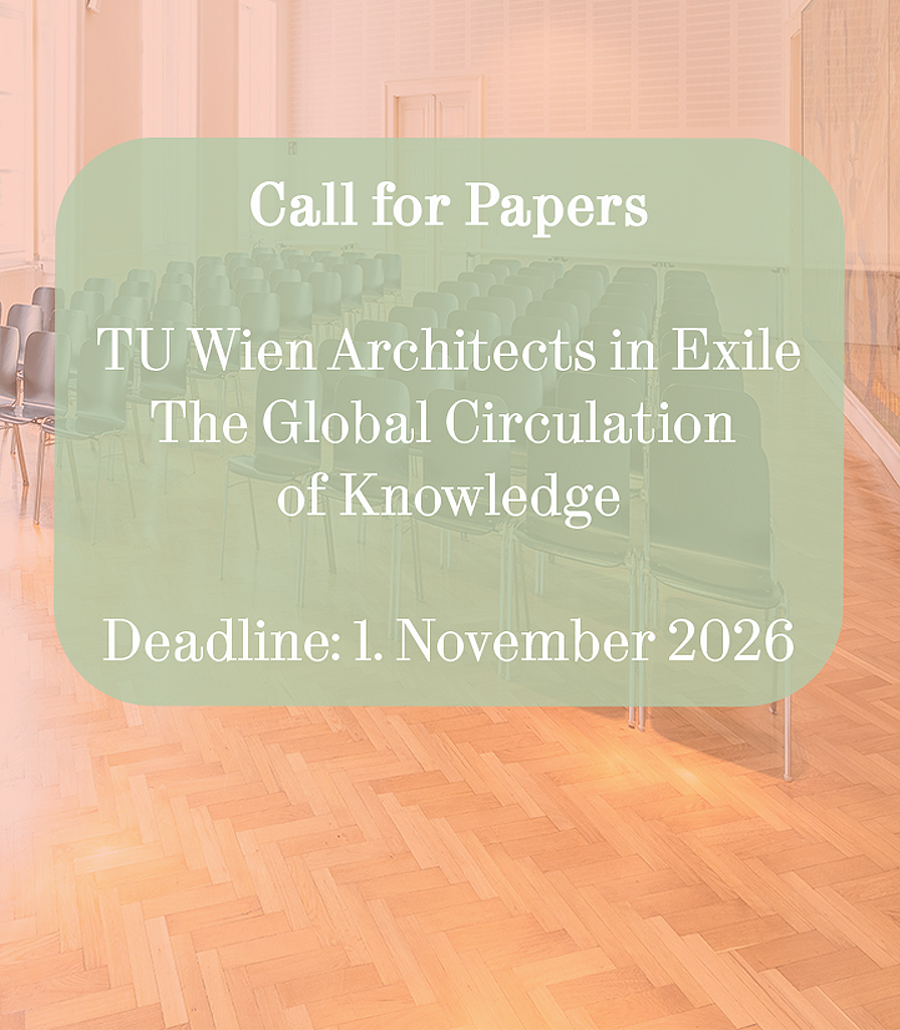
Call for papers – TU Wien Architects in Exile. The Global Circulation of Knowledge
Deadline: 01. November 2026
Call for papers
International Conference:
TU Wien Architects in Exile. The Global Circulation of Knowledge
21.-22.05.2027, TU Wien – Technical University Vienna
This international conference organised by the Art History Research Department at TU Wien explores the global circulation of architectural knowledge, focusing on architects who completed their training at the Technische Hochschule Wien and were forced into exile as a result of Nazi persecution. Beginning with the Technische Hochschule Wien as a shared place of education, the conference examines how architectural knowledge circulated, transformed and took on new forms worldwide through flight, displacement and exile, under varying cultural, political and institutional conditions. The focus is on the question of what role their training in Vienna played in their subsequent professional careers, and how the architectural concepts taught there evolved through interaction with the local building cultures and the social conditions of their respective host countries.
At the beginning of the 20th century, the Technische Hochschule Wien was one of the most important centres of architectural education in Central Europe. As a result of Nazi persecution, many of its graduates were stripped of their rights, displaced or forced to emigrate. Their personal and professional paths led them to different regions of the world, where they worked, taught and practised architecture under new political, social and cultural conditions. Their biographies provide an insight into the global interconnections of 20th-century architectural history and enable us to examine the international circulation of architectural knowledge from the perspective of a shared educational institution.
Although research into exile in architectural history has been an established field for decades, it has so far focused primarily on exile in the USA, Western Europe and Israel. Other regions of exile – particularly in Asia, Africa and South America – are just as under-represented as the biographies of female architects or lesser-known exile narratives. The conference aims to broaden these research perspectives and highlight the history of architects trained at the Technische Hochschule Wien in all its geographical and cultural diversity. In this context, the circulation of architectural knowledge is understood not as a one-way movement from a European centre to supposed peripheries, but as a reciprocal process of appropriation, translation and transformation, in which architectural ideas, local building traditions and diverse social contexts interacted to produce new forms of architectural practice.
We invite contributions that examine the biographies of architects who were trained at the Technische Hochschule Wien and who were forced to emigrate or go into exile as a result of Nazi persecution. We welcome both studies on individual figures and research into professional networks, institutional contexts and transnational exchange processes. Research that examines the influence of education at the Technische Hochschule Wien on architectural work in exile, taps into new biographical sources, or reconstructs previously unknown life stories and career paths is particularly encouraged. Contributions on under-researched places of exile, on female architects in exile, and on methodological, historiographical and memory-culture issues are also welcome.
The conference is intended as a forum for international academic exchange on the global circulation of architectural knowledge. It aims to place the diverse life and career paths of graduates of the Technische Hochschule Wien within a shared context, thereby opening up new perspectives on the international history of 20th-century architecture.
The selection of papers for the conference will be based on the abstracts submitted and will depend on the number of submissions. If not all papers can be presented during the conference, suitable papers will be included in the planned conference proceedings. Travel expenses for speakers invited to the conference will be covered in accordance with the available project funds, provided no other funding (e.g. through scholarships or academic appointments) is available.
Submissions
Please submit abstracts (max. 500 words) and a brief academic CV by 1 November 2026 to ingrid.holzschuh@tuwien.ac.at and vanessa.reiter@tuwien.ac.at (Link: www.kunstgeschichte.tuwien.ac.at).
Papers may be submitted in English or German.
Selected papers will be published in an academic anthology following the conference.